Watch the site
Five minutes through the live public site and the private CMS that keeps it current.
noCreativity transmission
Requested page is routing through noCreativity. Hold position while Ronny bolts the freakshow into the frame.
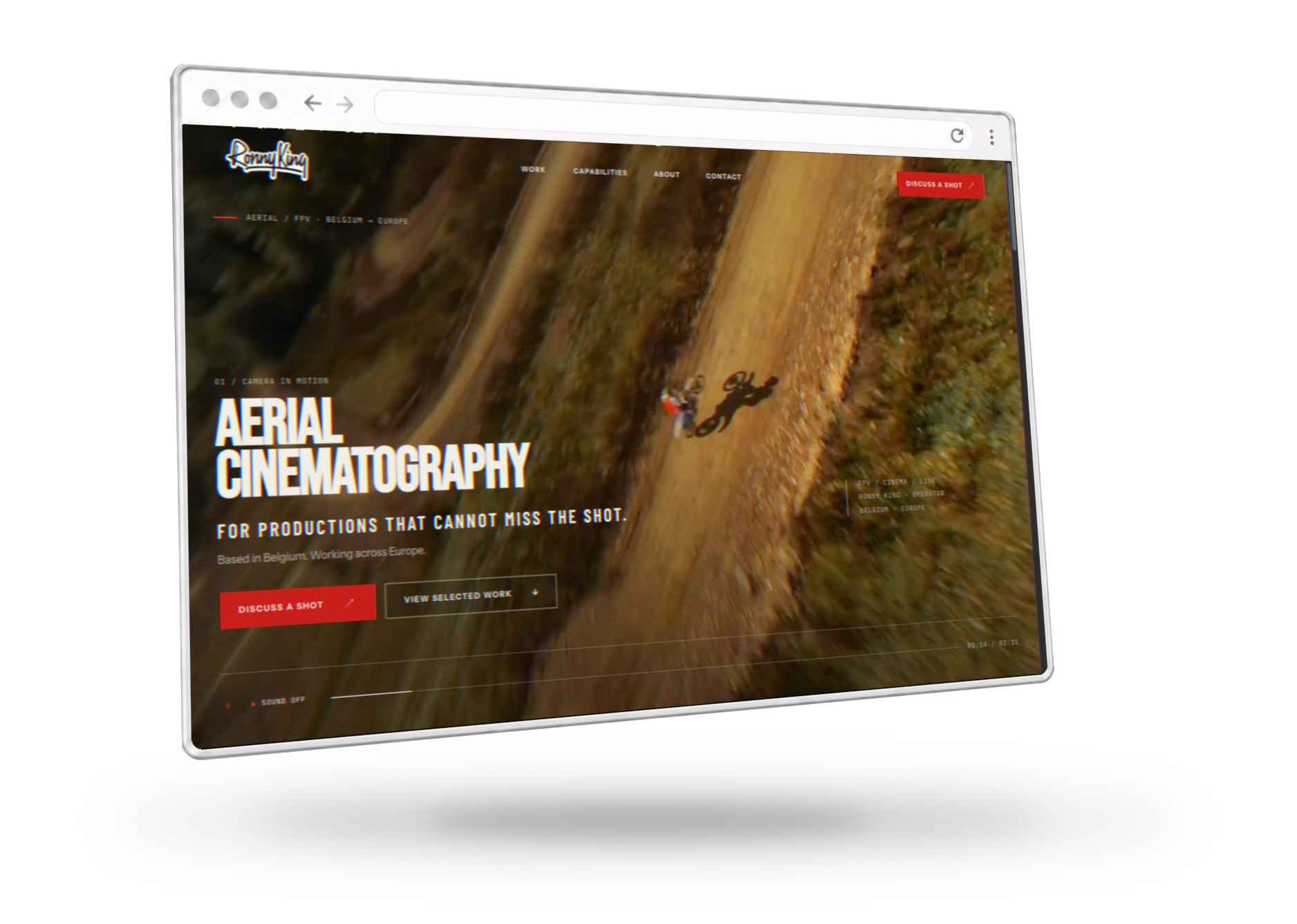
Ronny King needed a new home for cinematic aerial work before we left for a production shoot in Portugal. The old Squarespace plan was about to renew. Seventy-four hours after the first audit, the replacement was live: a fast public portfolio and a private control room built around the way the work is actually made.
From Squarespace to a custom production system in 74 hours.
Public experience first. The control room follows.
This five-minute walkthrough starts with the live public site, then steps behind it into the private production CMS. It shows the work as a visitor sees it before explaining the machinery that keeps it current.
The deadline was real.
The old Squarespace site held good material, but it read like a generic services brochure and kept the portfolio tied to an expensive annual renewal. We first archived it faithfully—pages, imagery and references intact—then rebuilt the experience around the films, the shots and the decisions that matter to a producer.
The catch: we were leaving for a drone shoot in Portugal within days, and the old plan would expire while we were away. There was no clean handover window. The replacement had to be ready before the flight.
The public site is built for producers and collaborators who want to understand the work quickly, see the range and turn a shot into a conversation.
A portfolio should not become stale the moment the developer leaves.
The private application is where the site becomes a real working tool. Ronny can draft and preview work, shape a visual story, manage the media library, publish when a project is ready and handle incoming production enquiries from the same system.
The screenshots here are not mockups. They come from the production admin: the control-room overview, the structured story editor, the media library and the inbox.
The Squarespace archive is a verified, locally runnable record: 13 routes, 1,508 downloaded assets, 150 sitemap images and four full-page captures. It keeps the original rendered HTML beside a rewritten offline version, blocks old forms from submitting, and preserves the unlinked shop and cart that normal navigation would have missed.
The work moved in visible steps before the Portugal shoot.
The first audit landed at 00:55 on 17 September. The first working homepage followed 1 hour 34 minutes later. Admin and CMS foundations were in place within the first day. The original Squarespace site was preserved as a runnable archive by hour 61. Production went live at 03:08 on 20 September.
74H 13M / audit to production
Four calendar days from audit to production. The first working homepage landed after 1 hour 34 minutes. Admin and CMS foundations were in place within the first day. The archive followed at hour 61, the story editor at hour 63, and production at hour 74.
The sequence matters: audit the Squarespace site, get a visual direction on screen, establish the admin and content model, preserve the source site, then tighten the public experience until it was ready to switch.
The point is not that every project should be rushed. It is that research, design, engineering and delivery can stay in one visible loop. Progress remains inspectable while the work keeps moving.
Selected milestones show how the work actually moved.
The public timeline explains the pace. The commit log underneath it shows the decisions and delivery steps that created that pace, from the first Squarespace audit to the documented production switch.
Selected main-branch evidence · local time
504e7fadocs: add Squarespace site audit and migration mapf4733d1docs: archive site assets and define homepage design274af91feat: build responsive cinematic homepageec0fcd2docs: approve homepage interaction correction305da37feat: refine cinematic homepage interactions71918d3docs: approve reference composition correction26e024bfeat: align homepage with approved visual references0740c44docs: approve Vercel prebuilt deploymentbc19b4cci: add Vercel prebuilt deploymentsaaeca2ddocs: approve admin platform architecture006a625feat: add Neon-backed admin platform29ba623docs: approve content management platforme251deefeat: add database-backed content platform5712eb7docs: design inline media uploadsc29f670feat: add contextual media uploads3cf72f1docs: approve cinematic capabilities dossier2f17766feat: add cinematic capability carousele988e73docs: define Squarespace archive workflow2df403earchive legacy Squarespace siteeda4e67docs: define visual story section editor8b94af3feat: add visual story section editor31ab2dcDocument live production status and canonical domainsMapped 12 public routes and 150 sitemap images, copied the reusable assets and turned the findings into an approved cinematic direction.
The first responsive homepage landed after 1h 34m. Prebuilt deployment, the private admin and the database-backed CMS followed before the first day was over.
Contextual uploads, capabilities, contact operations and the visual story editor turned the redesign into a site Ronny could run without Squarespace.
The legacy site was preserved, the canonical domains were documented live, and the replacement was ready before the Portugal production trip.
The replacement did not need another hosting subscription.
The old Ronny King site was on Squarespace Personal and was due to renew at €132 per year, plus applicable taxes. The replacement does not need another dedicated site subscription.
I already budget €240 per year for the shared production platform, and less than half of that capacity is currently consumed. Resource-efficient delivery and caching let this site fit inside what is already paid for, so it has little to no impact on the actual annual hosting bill.
Before / dedicated subscription
Now / fits inside existing capacity
The saving does not come from finding another cheap plan. The site uses resource-efficient technology and caching, so it fits inside hosting capacity that is already paid for. At the current usage level, this project has little to no impact on the actual annual bill.