Play Atlas
Six minutes through the complete Atlas system, from camera roll to home displays and VR.
noCreativity transmission
Requested page is routing through noCreativity. Hold position while Ronny bolts the freakshow into the frame.
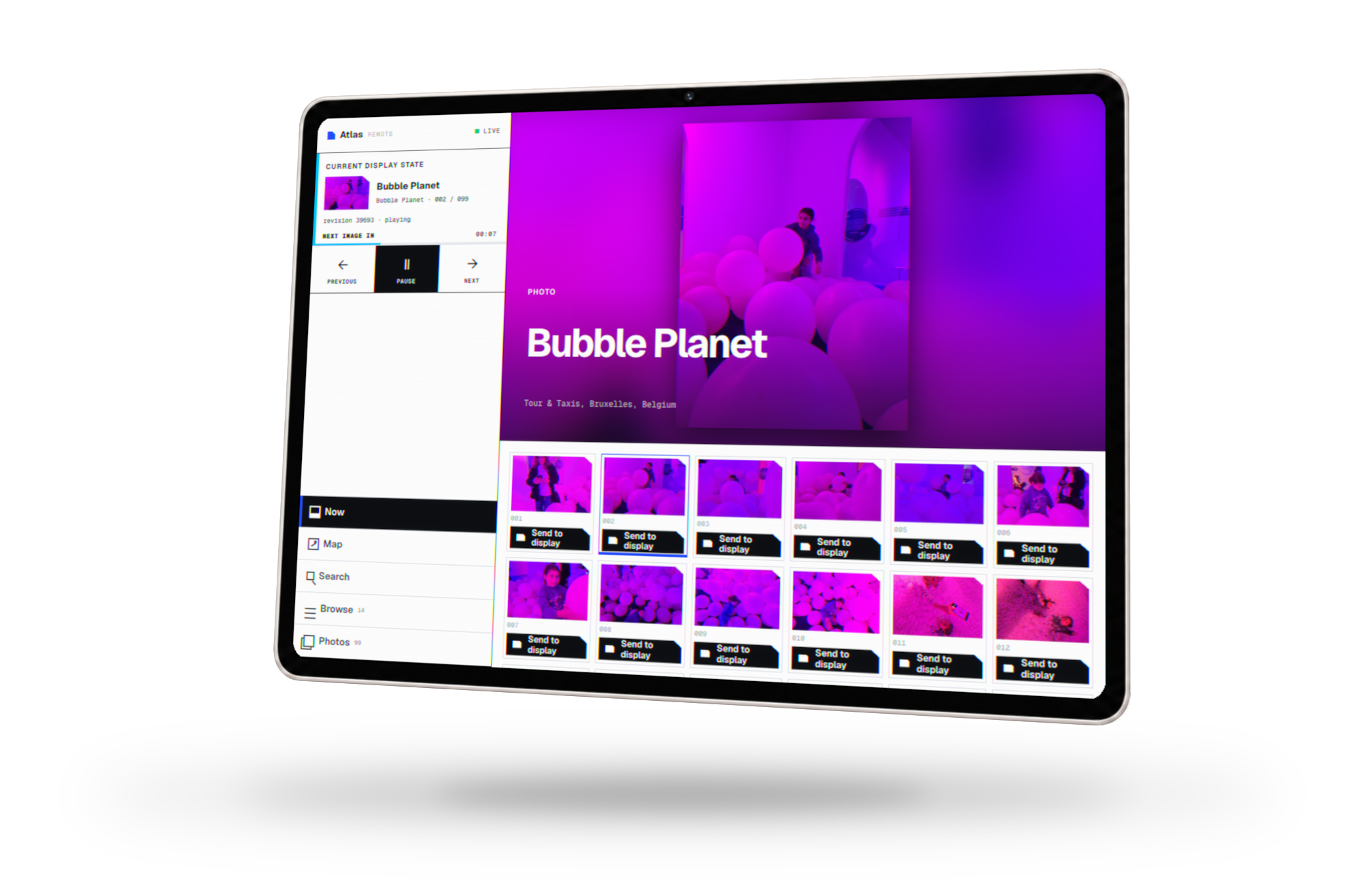
Atlas turns our travel photographs into something that actually lives with us. Photos arrive from our phones, become organised Memories, stay searchable by place and meaning, and move onto screens around the house or into VR.
A private photo system built across browser, Android, home displays and VR.
Not another folder full of forgotten pictures.
Atlas is the complete system around our travel photographs. It gets them out of the camera roll, preserves the originals, turns every trip or moment into a navigable Memory, and gives us several completely different ways to experience the same archive.
The browser is for exploration. Android is for intake and everyday use. The remote turns a phone into a storytelling controller. The living-room and fridge displays make the archive part of the house. The Quest lets us step inside it.
Atlas combines deliberate human-centred product choices with serious technical work. These are two independent perspectives on the complete platform, not a list of features paired with their implementation.
Every photograph belongs to a story.
A Memory can be a travel, an event or one special moment. It has its own cover, dates, route, ordered locations and stops. Inside it, photographs unfold by day and place instead of disappearing behind meaningless filenames.
The full-screen viewer keeps the photograph central but never loses its context. You can move through the sequence, inspect the evidence behind the date and location, download the preserved original, leave comments and likes, or jump straight into visually similar photographs.
A completely different way back in.
The archive is both chronological and geographic. The main map connects Memories, routes, locations and photographs to a shared timeline, making it possible to move through years of travel without starting from a folder or a search box.
Selecting a Memory reveals its route. Selecting a stop brings its photographs forward. The transition between overview, route and image keeps the geography visible instead of treating the map as decoration.
Names and places are only half the archive.
Atlas searches the obvious things, like Memory names, years and locations. It also understands visual meaning. I can describe the scene I remember, even when no person ever tagged it, and Atlas searches the photographs themselves.
Every photograph also becomes a new starting point. Find Similar moves into local image-to-image neighbours using OpenCLIP embeddings generated inside the household system. The private archive does not need to be sent to a remote recognition service to become discoverable.
A two-screen interface designed for talking to people.
The remote keeps control in my hand while the big screen stays completely focused on the story. I can move across a map, open a Memory, select a photograph and advance through a sequence without turning the display into a giant control panel.
That separation changes the social experience. The controller becomes quiet and practical. The shared screen stays beautiful. I can look at the people I am talking to instead of making everyone watch me operate a website.
One archive. Completely different rooms.
The huge landscape display in the living room and the portrait display on the fridge do not receive a stretched version of the same webpage. Each has its own composition, type scale, image treatment and information rhythm.
Atlas can become an active storytelling screen or simply stay alive in the background. Slideshows, captions, timing and progress are composed around the room and the hardware, so the pictures feel present without constantly demanding attention.
The VR experiment that became one surface inside something much bigger.
On the Meta Quest 3, Atlas becomes a spatial photo sphere. Photographs surround the viewer, the menu exists in the same space, and selecting a direction turns browsing into physical exploration instead of a flat grid.
The same system can also become a passive 360-degree globe for ambient presentation. VR matters here, but it is deliberately one part of Atlas rather than a separate novelty bolted onto the archive.
The Android app is where photographs enter the system.
I can select photographs in the camera roll, use the normal Android share sheet, choose or create the right Memory, review the complete staged batch and start the upload. Every file has visible progress and durable state, so an interrupted connection does not turn a large selection into a guessing game.
The app continues far beyond intake. It contains the canonical Memories, Places, map, photo viewer, comments, likes and editing flows, plus its own authenticated production-update path. It feels like Atlas on a phone, not a website wrapped in an icon.
Pretty interfaces are useless if the archive underneath them cannot be trusted.
Atlas preserves every accepted original byte-for-byte before it creates anything convenient for the interface. It extracts the source metadata, handles HEIC and Live Photos, corrects display orientation without rewriting the source, detects duplicates and creates exactly the derivatives the product needs.
Upload acceptance and media processing are separate, visible states. Durable database-backed jobs can survive interruption and retry without asking for the original again. Local OpenCLIP processing then makes the archive searchable by visual meaning.
A complete household server stays inside the home network. A separate, deliberately tiny public runtime handles approved authentication and uploads away from home without exposing the display, admin, VR or operational surfaces.
The styleguide was product infrastructure.
I did not want Atlas to become another tasteful beige photo app. It had to be bright, physical, playful and extremely clear, even while moving between a browser, an Android phone, two wildly different displays and a VR environment.
That took several real design rounds. A warm editorial worktable, a louder colour-block experiment and a refined third direction all helped expose what the system needed. The final language became a huge explicit styleguide instead of a loose collection of screens that happened to look similar.
Typography, semantic colour, 40-degree cut corners, icon ownership, photo treatment, focus states, accessibility, responsive behaviour and staged 180, 420 and 720 millisecond motion all have rules. That is why Atlas can change shape without losing its identity.
A home platform with an intentionally small door to the internet.
The system has purpose-built clients, two web applications, a complete household authority, a restricted public server, PostgreSQL, mounted original storage, durable media processing, a local OpenCLIP worker and a production Android release pipeline.
Every responsibility has a boundary. The public runtime can authenticate approved people, accept uploads and deliver app releases. It cannot become a shortcut into the household display, admin, VR, embeddings or operations.
It is full of real photographs and it is already part of the house.
The clearest proof of Atlas is not the feature list. It is the fact that we are using it. The active archive already contains thousands of photographs, and the codebase includes the tests, operational tooling and documentation needed to keep that archive safe while the product keeps growing.
Theme, structure and media remain independent.
204 commits on main.
The target was less than 24 hours. The first version was in use after roughly 30. By the end of day three, Atlas had become the highly complete platform shown on this page.
Codex was the implementation partner working through the repository and, later, an ADB-connected phone. I drove the scope, architecture, permissions, security, design rules, CSS, animation, corrections and final acceptance. It was not one prompt. It was a ridiculous amount of tightly directed work moving at a ridiculous speed.
The full Blackbook, Ely, VR experiment and overnight-build story will become a separate article.
Atlas is already part of how Ely and I take pictures, get them into the archive, rediscover them together, leave them alive around the house and show our friends where we have been.